
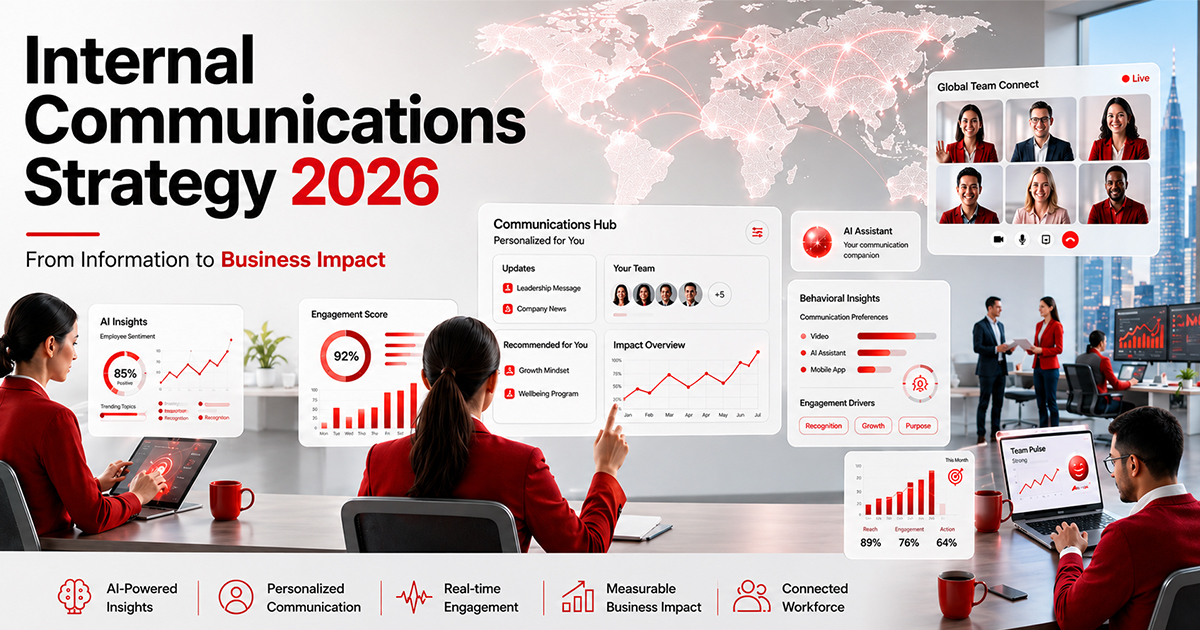
Internal communications has evolved from a support function into a core strategic capability that directly impacts business performance, employee engagement, and organisational alignment.
Global organisations such as Microsoft, Unilever, Booking.com, and ING are redefining their internal communications strategy to keep pace with rapid transformation, AI adoption, and increasingly complex workforce structures.
In 2026, communication is no longer about simply informing employees. It is about:
- influencing behaviour
- enabling transformation
- driving measurable outcomes
Companies like Deloitte and Philips are shifting toward continuous communication ecosystems, moving away from static, top-down messaging and embracing real-time, employee-centric communication.
At the same time, digital workplace transformation is reshaping how communication is delivered. Organisations such as Google and Aegon are building AI-powered employee hubs that provide personalised, relevant, and accessible communication experiences.
A strong employee engagement strategy is now inseparable from communication. Companies like Skyscanner and Coty are using communication to build trust, reinforce culture, and connect employees to purpose.
The most effective organisations are adopting key internal communications best practices, including:
- personalisation at scale
- reducing information overload
- data-driven communication decisions
- integration with employee experience strategies
These trends reflect a broader shift across the industry, where communication is becoming a measurable business driver rather than a support function.
Conclusion & Next Steps
Internal communications strategy in 2026 is about impact, not output.
If you want to explore how organisations like Microsoft, ING, Booking.com, and Philips are redefining communication, join Europe's leading internal communications conference in Amsterdam on 2–3 June.