

Change Has Become Constant — Communication Determines Success
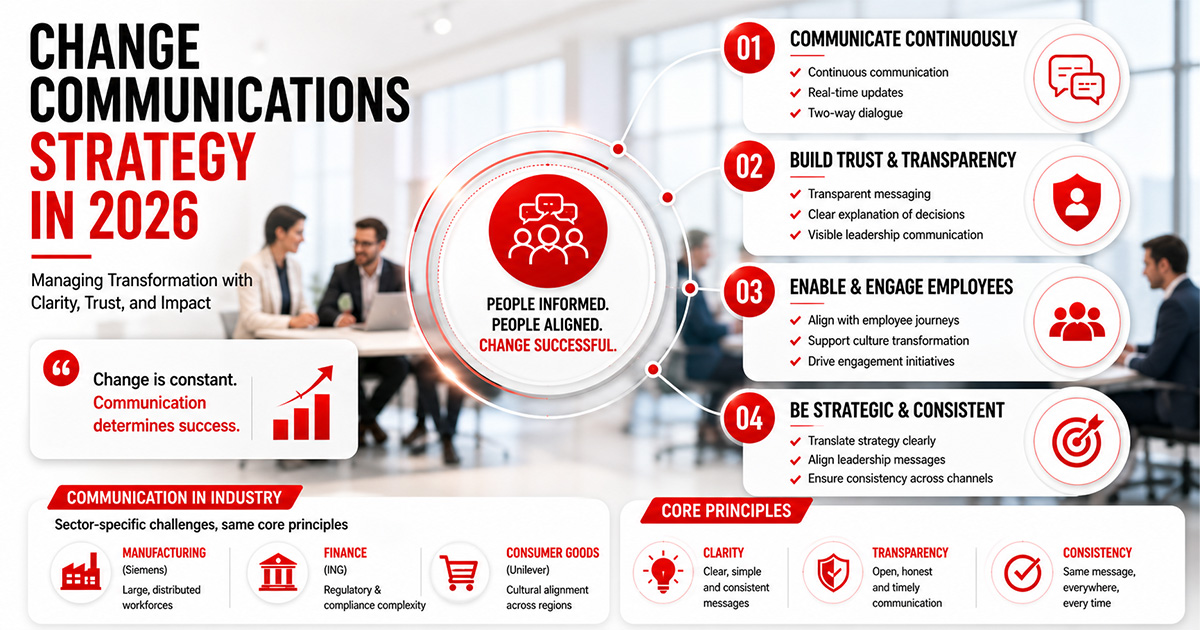
In today's business environment, transformation is no longer occasional — it is continuous.
Whether driven by digitalisation, AI adoption, restructuring, or geopolitical uncertainty, organisations are constantly evolving. In this context, a strong change communications strategy is no longer optional — it is essential.
European leaders such as Siemens, Aegon, Philips, and Henkel demonstrate that successful transformation depends on clear, consistent, and trusted communication.
From One-Way Announcements to Continuous Dialogue
Traditional change communication relied on:
- top-down announcements
- one-time updates
- static messaging
This approach no longer works.
Modern organisations are shifting toward:
- continuous communication
- real-time updates
- two-way dialogue
Companies like ING embed change communication into daily communication flows, ensuring employees remain informed and aligned throughout transformation processes.
Building Trust Through Transparency
Trust is the most critical factor in any change initiative.
Organisations such as Rabobank and Atradius focus on:
- transparent messaging
- clear explanation of decisions
- visible leadership communication
Employees are far more likely to embrace change when they understand why it is happening, how it affects them, and what is expected of them.
The Role of Internal Communications
Internal communications teams are now central to transformation.
Their role includes:
- translating strategy into clear messages
- aligning leadership communication
- ensuring consistency across channels
This elevates corporate internal communications from a support function to a strategic enabler of change.
Connecting Change to Employee Experience
A strong change communications strategy must also consider employee experience.
Companies such as Airbus and Unilever align communication with:
- employee journeys
- cultural transformation
- engagement initiatives
This ensures that change is not just communicated — it is experienced in a meaningful and manageable way.
Communication in Industry: Sector-Specific Challenges
Different industries face unique communication challenges:
- Manufacturing (Siemens): large, distributed workforces
- Finance (ING): regulatory and compliance complexity
- Consumer goods (Unilever): cultural alignment across regions
Despite these differences, the core principles of communication in industry remain consistent:
- clarity
- transparency
- consistency
Conclusion & Next Steps
Change is inevitable — but successful transformation depends on communication.
Organisations that invest in strong change communication will:
- reduce resistance
- build trust
- accelerate adoption
If you want to explore how leading organisations manage transformation through communication, join Europe's leading internal communications conference in Amsterdam.